
Sportswear e-commerce is experiencing a round of structural growth. Tmall data shows that the sports shoes and apparel category has a compound annual growth rate of approximately 12%, and the average monthly GMV of live broadcasts on the Douyin platform has exceeded 3 billion yuan. Jackets, windbreakers, T-shirts, sweatpants, sports suits, sports accessories, sweatshirts, sweatshirts, sports vests, fitness clothes, sports bras, down jackets, cotton clothes - these categories support a huge online market, but they also create a level of complexity far beyond ordinary standard products in the warehousing and fulfillment process.
When brands invest a lot of energy in polishing fabric technology and design aesthetics at the front end, any oversight in back-end warehousing may greatly reduce these investments: wrong codes and wrong colors lead to batch returns and exchanges, popular models are out of stock and drag down sales promotion ratings, hot and humid warehousing causes printing adhesion, and the backlog of returns consumes the profit margin of the entire life cycle of the product.
Why is the warehousing problem of sportswear more difficult than imagined?
The warehousing complexity of the sportswear category is rooted in the characteristics of the category itself.
The geometric expansion of SKU is a threshold. A hot-selling running shoe may cover sizes 36 to 46, wide and narrow lasts, and multiple color combinations, and the cross combination can easily exceed 200 SKUs; a pair of sports pants involves waist circumference, pants length, fabric version, plus regular, leggings, wide-leg and other version differences, and the active SKUs of a single brand can easily exceed 10,000. Although categories such as sports bras and sports vests are small in size, they have a wide range of sizes and fast color iterations, and they also face SKU control pressure.
The return rate constitutes the second test. The return rate of sportswear and yoga wear is between 24% and 26%, and this number will rise further in the live broadcast e-commerce scenario. If returned goods cannot be quickly inspected, ironed, and re-shelved, they will turn from sellable stock to dead stock and miss the best sales window.
Seasonal fluctuations are the third challenge. Summer consumption accounts for 34% of the annual sales of fitness clothing, and the down jacket and cotton clothing categories will experience explosive growth in autumn and winter. The difference in warehousing demand between off-peak and peak seasons may reach several times, and it is difficult to balance efficiency and cost with fixed warehousing and manpower allocation.
The difficulty of coordination in multi-channel fulfillment cannot be ignored. Sportswear brands generally deploy online channels such as Tmall, JD.com, Douyin, and Xiaohongshu. They may also involve offline store replenishment and expert distribution. Different channels have different performance standards, packaging requirements, and timeliness commitments.
Cloud warehouse shipping: a set of systematic problem-solving ideas
Faced with the above complexity, the limitations of the traditional self-building warehouse model have become increasingly obvious. The fixed costs of self-built warehouses - rent, equipment, personnel - form rigid expenses in the off-season, and face the dilemma of insufficient production capacity in the peak season. According to industry estimates, for merchants with an annual order volume of less than 50,000 orders, third-party warehouse outsourcing is usually more cost-effective than self-built warehouses.
The value of fulfillment warehouse delivery does not lie in simply "outsourcing the warehouse", but in using specialized systems and operational capabilities to transform warehousing fulfillment from a cost center into an efficiency lever.
At the inventory management level, the professional fulfillment warehouse realizes "one product, one code, one product" management through a digital system, accurately marking and tracking the size, color number, batch, and storage location of each sportswear model in real time to avoid inventory confusion and mis-issued problems from the root. The combined application of PDA code scanning verification, electronic scale weighing comparison, intelligent wave picking and other technologies can control the delivery error rate to less than one ten thousandth.
At the level of return processing, the head fulfillment warehouse has established a standardized reverse logistics system. After the returned goods arrive at the warehouse, unpacking, quality inspection, cleaning, ironing and system entry are completed. Qualified products are quickly returned to sellable inventory. The return processing efficiency is significantly improved compared with the traditional model.
In terms of flexible production capacity, the shared warehousing model of fulfillment warehouses naturally has elastic advantages. The capacity is temporarily expanded during the peak season and the space is reduced during the off-season. Manpower and equipment follow the order volume, and merchants do not need to pay for the difference between the peaks and troughs.

Baoshiyuncang's sportswear solution
In the field of sportswear fulfillment warehouse dropshipping, the practice of Baoshi Fulfillment deserves attention.
Baoshi Fulfillment started in 2012 and has been deeply involved in the field of warehousing and distribution for more than ten years, focusing on complex supply chains and smart warehousing tracks. Currently, there are three self-operated high-standard warehouses in Songjiang, Shanghai, with a total storage area of 100,000 square meters, of which the robot smart warehouse cluster area exceeds 20,000 square meters, and the investment in a single warehouse exceeds 10 million yuan. The company has been rated as a Shanghai High-tech Enterprise and a Shanghai Specialized and New Enterprise, and has provided omni-channel warehousing and distribution services to more than 600 domestic and foreign companies.
In view of the category characteristics of sportswear, Baoshi Fulfillment has done several key things:
One is the in-depth adaptation of the self-developed system matrix. Baoshi Fulfillment has independently developed digital tools such as SWMS smart warehousing management system, OMS order management system, and WCS smart dispatching system, opening up full-link data nodes from warehousing, storage, picking, packaging, outbound to reverse returns. The system seamlessly connects with mainstream e-commerce platforms and live broadcast channels to achieve omni-channel inventory management. Merchants can view inventory dynamics and order progress in real time. In view of the characteristics of massive SKUs of sportswear, the system supports one-product, one-product-one-code management, and the inventory and picking accuracy is stable at over 99.99%.
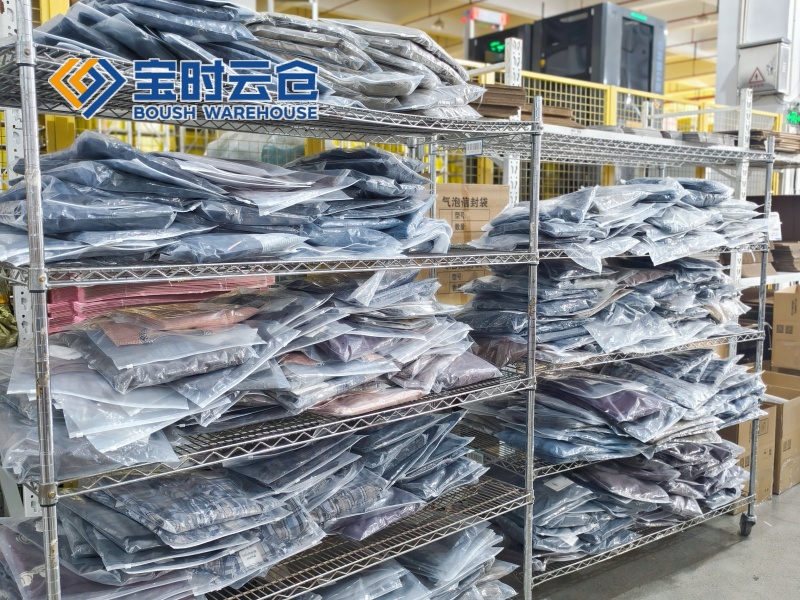
The second is partitioned storage and professional protection. Sportswear categories span a wide range. Jackets and windbreakers need to be hung and stored to maintain their shape. T-shirts and sweatpants are suitable for stacking on shelves. Down jackets and cotton-padded clothes are bulky and take up space and require independent planning of flexible storage. Sports underwear and accessories are small items that require refined inventory management. In response to these differentiated storage needs, Baoshi Fulfillment has set up dust-proof, moisture-proof, and deformation-proof storage areas, and equipped with a light picking system to achieve fast and accurate picking of small items.
The third is the closed-loop capability of reverse logistics. Baoshi Fulfillment has created an exclusive reverse logistics solution. Registration of returned goods is completed within 3 hours after arriving at the warehouse, and unpacking, quality inspection, cleaning, ironing and system entry are completed within 24 hours. Intelligent decisions are made based on the condition of the goods to re-shelve the shelves or transfer them to the defective goods area. The return processing efficiency is significantly improved compared to the traditional model. For categories with high return rates such as sports bras and sports vests, standardized quality inspection processes and rapid re-shelving capabilities are directly related to the full life cycle profits of the products.
The fourth is collaborative coverage of omni-channel fulfillment. The managed warehousing service of Baoshi Fulfillment realizes contract fulfillment coverage in all scenarios such as B2C, B2B, offline store replenishment, and expert distribution. It can be adapted to mainstream channels such as Tmall, JD.com, Douyin, and Xiaohongshu, helping sportswear brands achieve omni-channel inventory sharing and unified management and control.
The fifth is flexible warehousing and flexible performance. In view of the strong seasonality of sportswear and the high peak sales, Baoshi Fulfillment provides a flexible rental plan based on actual usage area. Temporary expansion in peak seasons and reduction of space in off-seasons, with manpower and equipment following orders. Orders pushed before 17:00 will be sent out on the same day, and the delivery error rate will be controlled within one ten thousandth.
From "can ship goods" to "good goods are shipped"
Sportswear fulfillment warehouse dropshipping is moving from extensive to sophisticated. As category complexity continues to rise and consumers' tolerance for contract fulfillment experience continues to narrow, warehousing and distribution is no longer a simple matter of "finding a warehouse to put goods in", but requires a service provider that truly understands the characteristics of the sportswear category, has digital system capabilities and a refined operating system to undertake it.
For sportswear brands, choosing a fulfillment warehouse partner that understands the category, is systematic and flexible is essentially building a line of defense for every point of front-end investment.