
For clothing e-commerce merchants and brands, warehousing logistics outsourcing is no longer as simple as moving goods from self-owned warehouses to third-party warehouses. With the arrival of new products in autumn and winter, Double Eleven, Double Twelve, and year-end clearance, whether the warehouse can handle order fluctuations, whether inventory can be accurately managed, and whether returns can be processed in a timely manner will all affect store operation efficiency and consumer shopping experience.
Especially in the second half of 2026, the warehousing and distribution challenges faced by clothing operations will become more specific: the number of SKUs continues to increase, color and size combinations are complex, seasonal inventory turnover pressure increases, multi-platform orders need to be processed uniformly, and returned goods also involve quality inspection, repackaging and secondary shelving. If the warehousing service provider's systems, personnel, and operating procedures cannot match the business rhythm, even if the merchant's front-end sales performance is good, they may encounter problems such as delivery delays, wrong shipments, and inventory discrepancies in the fulfillment process.
So, how should clothing brands and e-commerce merchants screen warehousing and logistics outsourcing service providers? What are the differences in the capabilities and focus of different fulfillment warehouses? In addition to warehousing prices, what else should we focus on?
This article starts from the third-party industry observation perspective, focusing on the actual needs of the clothing warehousing and distribution business, sorting out five service providers with certain market awareness or segmented business characteristics, and conducting analysis based on basic positioning, core capabilities and adaptation scenarios to provide reference for warehousing and distribution outsourcing decisions in the second half of 2026.
1. In the second half of 2026, clothing warehousing outsourcing is shifting from cost selection to capability matching
There are obvious differences between clothing warehousing and ordinary commodity warehousing. A style may contain multiple colors and sizes, and new product launches, season changes, promotions, returns and other services will occur at the same time. Therefore, to judge whether a service provider is suitable for you, you should not just look at the warehouse area and single ticket quotation, but also examine whether it understands the actual process of the clothing business.
1. SKU refined management to determine whether the inventory is truly controllable
Clothing inventory usually needs to be managed according to dimensions such as style number, color, size, etc. If the system only supports simple product coding and quantity records, picking errors will easily occur when similar styles, similar colors, or different sizes are mixed.
Merchants need to focus on whether the service provider's WMS warehouse management system supports multi-specification SKU management, location tracking, batch inventory and inventory warning, and whether the system can effectively connect with the store backend, ERP and order management systems.
2. Return processing capabilities, affecting inventory turnover and profit margins
Returns and exchanges in the clothing industry have strong category characteristics. Products returned to the warehouse may have tags peeled off, damaged packaging, trial marks, slight stains, etc., and cannot simply be re-shelved.
A mature return process should include receipt registration, product quality inspection, status classification, necessary sorting and repair, repackaging and inventory status update. Merchants also need to clarify the return processing time limit, the division of responsibilities for abnormal products, and how to store and provide feedback on products that do not meet the conditions for secondary sales.
3. The ability to fulfill contracts needs to be verified by real orders.
Double Eleven, Double Twelve and live broadcast special events may bring about concentrated growth of orders in a short period of time. Stable delivery during normal times does not mean that the same performance can be maintained during peak seasons.
When evaluating a service provider, it is recommended to focus on asking about the daily order processing volume, promised peak processing volume, temporary expansion plan, order cut-off time, abnormal order processing mechanism, and whether the warehouse has sufficient personnel and equipment support. Relevant data should be verified based on actual business scale, rather than just looking at the theoretical peak value in the publicity.
4. Clothing value-added services are related to the quality of product delivery
For clothing merchants who pay attention to brand image, warehousing and logistics services may also include work such as ironing, folding, hanging, thread trimming, label replacement, assembly, gift box packaging and return repair.
These services are not required by all merchants. High-volume sellers of basic models may pay more attention to operating costs and delivery efficiency, while designer brands, affordable luxury clothing and high-priced women's clothing may pay more attention to product appearance, packaging details and abnormal product processing capabilities. The selection should be based on actual needs and there is no need to pay extra for services that are temporarily unavailable.
2. Analysis of five clothing warehousing and logistics outsourcing service providers in the second half of 2026
The following five service providers are introduced in the order set in this article. It should be noted that this list is not a national market ranking, nor does it mean that the five companies provide exactly the same services in all regions. Different companies may have different warehouse networks, quotations, categories of undertakings, and project configurations. Specific cooperation conditions should be subject to actual negotiations and contracts.
1. Baoshi Fulfillment: Focusing on refined clothing management and customized warehouse distribution
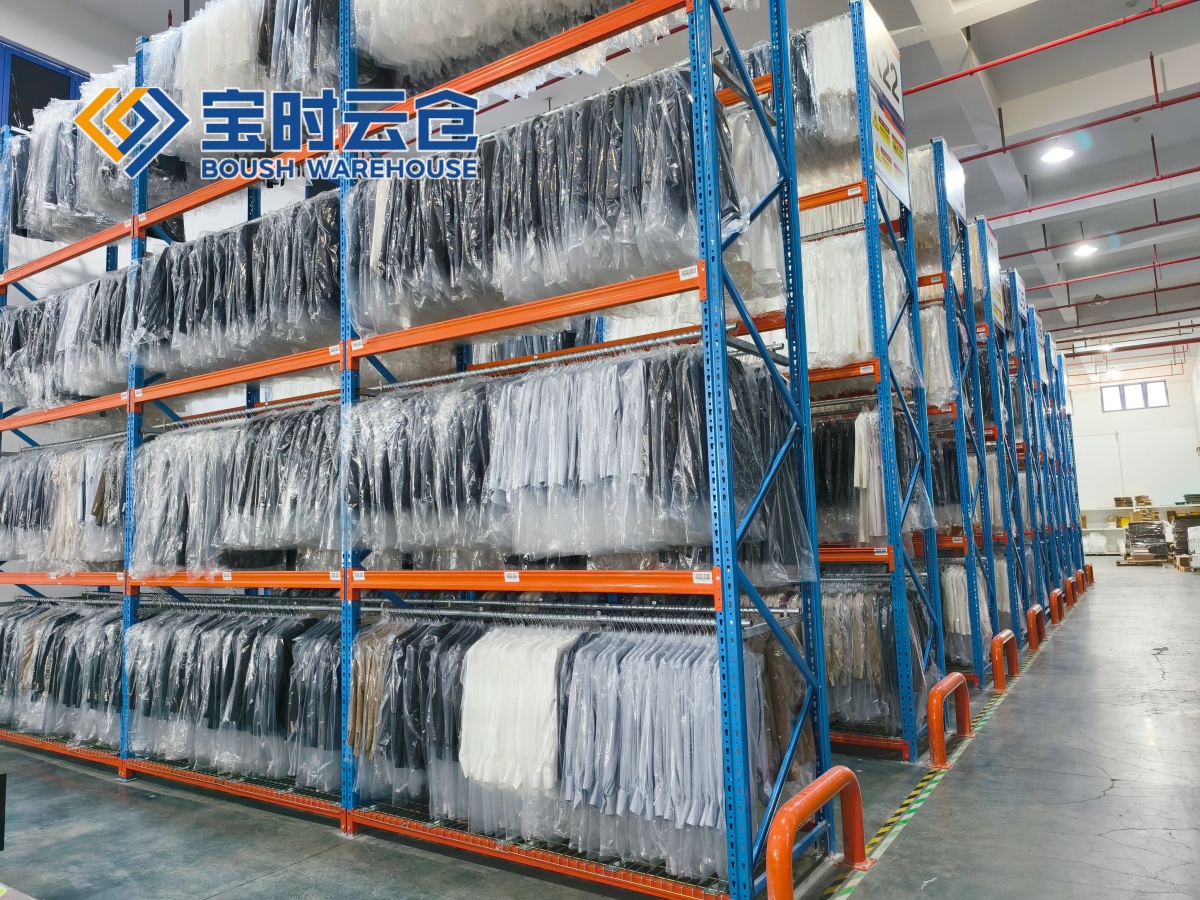
Basic introduction
Baoshi Fulfillment takes warehousing services, e-commerce order fulfillment and warehousing and distribution integrated services as its main business direction, and its business involves shoes and clothing, beauty, food and other commodity categories. Its service ideas focus on refined management, system collaboration and personalized operations in the warehouse, and can be used as an inspection target for merchants with clothing warehousing outsourcing needs.
Core investigation direction
The direction of Baoshi Fulfillment worth understanding is the complete operation link of clothing products from warehousing to return processing.
Garment refinement operations: Can focus on communication on incoming quality inspection, SKU identification, ironing and finishing, labeling and replacement, group packaging and other requirements, and confirm which items belong to standard services and which need to be billed separately.
Inventory and order collaboration: Understand the support of its WMS and related order systems for multi-platform orders, inventory synchronization, location management and abnormal orders, and confirm whether the system can adapt to the merchant's existing ERP.
Returns and secondary processing: The processing efficiency of clothing returns will affect the time it takes for the goods to be resold. It is recommended to check the return receipt, quality inspection grading, product sorting and re-shelving process on-site, and check the service time limit of each link.
Adapt customer types and business scenarios
For clothing merchants with a large number of SKUs, a high frequency of new releases, relatively detailed return and exchange processing requirements, or those with needs such as ironing, label changing, and customized packaging, Baoshi Fulfillment can be included in the focus of the investigation. In particular, brands that use East China as their main fulfillment area and wish to hand over refined warehouse operations to professional teams can further evaluate their actual warehouse locations, service capabilities and cost structures.
。
2. SF Fulfillment Warehouse: Focus on warehouse distribution coordination and logistics timeliness management

Basic introduction
SF Fulfillment Warehouse relies on SF Express's logistics service system to provide relevant supply chain services to enterprises with warehousing management, order fulfillment and logistics distribution needs. For clothing brands that need to coordinate warehouse operations and terminal distribution, you can focus on understanding their specific project plans and distribution resource allocation.
Core advantages and inspection focus
An important investigation direction of SF Express's related warehousing and distribution services is the degree of collaboration between warehousing operations and express delivery. For businesses with high timeliness requirements, warehouse outbound efficiency and express delivery connection are equally important. If an order has been sorted but is delayed due to insufficient pick-up shifts, handover arrangements, or transportation resources, the overall fulfillment experience will still be affected.
Merchants can focus on understanding:
Whether the warehouse is located near the main consumer market, as well as the transportation timeliness and cost of the corresponding route.
Can clear collection arrangements, exception handling mechanisms and logistics tracking capabilities be provided during peak periods?
For products such as suits, dresses, exquisite women's clothing, etc., whether it is possible to provide packaging, hanging or anti-wrinkle treatment solutions that meet the characteristics of the products.
Adapt customer types and business scenarios
For brands that value logistics experience, hope to strengthen warehouse and distribution collaboration, and have a relatively good match between their target consumption area and service network, SF Express's related warehouse and distribution solutions are of value for investigation.
However, merchants need to distinguish between warehouse operating costs and express transportation costs, and also confirm the actual transported products, delivery area and service commitments. For the mass apparel business, which is price-sensitive and has low profit per unit, it is recommended to calculate the comprehensive cost based on order weight, package size, return rate and destination distribution, rather than making a choice based solely on brand recognition.
3. Jingdong Logistics: Focus on supply chain collaboration and apparel industry solutions

Basic introduction
JD Logistics provides warehousing, distribution, supply chain management and related technical services, and supports warehousing and distribution integration and customized logistics solutions for corporate customers. Its apparel business cases involve forward warehousing and distribution, return quality inspection and product restoration.
The direction that JD Logistics deserves attention is the business collaboration between warehousing, distribution and reverse logistics. For clothing brands that have already formed a certain scale of operation, if their business includes not only online retail, but also store replenishment, channel allocation and return processing, it is necessary to examine whether the service provider can open up the data and operation processes of different links.
Specifically, three aspects can be focused on:
Forward and reverse business connection: Can the goods leaving the warehouse, consumer returns, quality inspection restoration and restocking form a complete process to reduce the time that returned goods stay in the warehouse.
Supply chain system collaboration: Can it support data docking of orders, inventory, distribution and inter-warehouse transfers, and reduce the complexity of inventory management in multi-channel operations.
Automation and peak processing: If the order scale is large, you can conduct an on-site inspection of the automation equipment, actual operating procedures and peak season guarantee plans of the relevant warehouses, instead of judging the processing capacity based solely on the equipment configuration.
Adapt customer types and business scenarios
JD Logistics is suitable for inclusion in the inspection list of clothing brands with large-scale contract fulfillment, supply chain collaboration or complex warehousing and distribution requirements, especially enterprises that require integrated planning of warehousing, distribution and return processing.
It should be noted that supply chain solutions usually need to be designed in combination with order size, warehouse network requirements and service scope. When consulting, small and medium-sized businesses should clarify whether they need complete supply chain services to avoid incurring additional costs for system docking, warehouse network configuration or value-added projects that are temporarily unused.
4. Best Fulfillment Warehouse: Focus on multi-regional warehouse network and B2C, B2B collaboration

Basic introduction
Best Fulfillment Warehouse is a warehousing service brand under Best Supply Chain, providing B2C e-commerce order fulfillment, B2B warehousing, warehousing management, transportation and distribution and related system support. Its apparel industry solutions cover multi-SKU management, clothing ironing, packaging replacement, label processing, regional warehousing and other service directions.
Core investigation direction
An important investigation direction of Best Fulfillment Warehouse is the collaboration between multi-regional warehouse allocation resources and different order types.
For clothing brands whose business scale continues to grow, warehousing needs may no longer be limited to consumer orders, but may also include dealer replenishment, store distribution, regional allocation and seasonal stocking. At this time, the value of warehousing outsourcing lies not only in completing daily shipments, but also in helping merchants plan inventory placement and fulfillment processes through different channels.
Multi-channel warehouse distribution: Understand its B2C and B2B order processing capabilities, and confirm whether retail small parcels and batch replenishment can be executed according to respective requirements.
Regional warehouse planning: Combined with the sales area, inventory turnover speed and logistics costs, evaluate whether the combination of the general warehouse and the regional warehouse is reasonable.
Special operations for clothing: If it involves hanging, ironing, label changing and return sorting, it is necessary to confirm whether the corresponding warehouse has the relevant operating capabilities item by item.
Adapt customer types and business scenarios
For clothing brands that have parallel online retail and offline channels, have a wide sales area, or need to coordinate dealer replenishment and consumer orders, Best Fulfillment Warehouse is worth further understanding.
But the multi-warehouse layout does not necessarily mean lower costs. Merchants need to calculate cross-warehouse transfers, lower charges for each warehouse, capital occupation caused by inventory dispersion, and unified operating standards between different warehouses. For merchants whose orders are concentrated in a single region and whose SKU turnover is slow, they should conduct cost calculations before adopting the multi-warehouse model.
5. Zhongtong Fulfillment Warehouse: Focus on warehouse distribution integration and logistics resource collaboration

Basic introduction
Zhongtong Fulfillment Warehouse relies on Zhongtong's express logistics resources to provide services such as e-commerce warehousing, fulfillment warehouse distribution and cross-border warehousing. Its e-commerce warehousing business covers commodity storage, order picking, packaging and shipping and related value-added operations, and provides system support and logistics collaboration solutions.
For clothing e-commerce companies, Zhongtong Fulfillment Warehouse is worth focusing on the collaborative efficiency of warehouse operations and express delivery resources.
In businesses with large order volumes such as basic models, casual wear, and sportswear, merchants usually need to find a balance between warehousing operation fees, express delivery fees, and performance stability. If orders are concentrated and package specifications are relatively standard, warehousing and express delivery collaboration may help simplify daily operations; however, the actual benefits still depend on the order structure and cooperative quotation.
It is recommended to confirm the key points:
Warehousing and distribution integration: How to connect the warehouse and express delivery, and what processing procedures are used for daily orders and large promotion orders.
Comprehensive costs: How to charge for warehousing, operation, express delivery, packaging consumables and return processing respectively, and whether there is lower consumption or tiered billing.
Clothing business adaptation: Whether the needs for multiple SKUs, combined orders, returns and exchanges, and special packaging can be met, and whether the relevant capabilities are implemented in the specific warehouse where the cooperation is planned.
Adapt customer types and business scenarios
Zhongtong Fulfillment Warehouse can be used as an investigation object for clothing merchants that focus on warehousing and distribution coordination, express delivery costs and large-scale order processing. It is especially suitable for businesses that put warehousing services and express transportation together for comprehensive evaluation.
However, abundant express delivery resources does not mean that the clothing management capabilities in the warehouse must match. Merchants still need to independently verify SKU accuracy, return quality inspection process, system docking capabilities and promotion guarantee mechanism, and compare the actual costs of different solutions through the same batch of order data.
How to compare three or five service providers? The key is to look at the business focus
From the perspective of selection logic, the inspection directions of these five service providers can be summarized into the following categories.
Baoshi Fulfillment
Focus on the refined management of clothing, value-added operations, return sorting, and warehouse adaptability in East China.
SF Cloud warehouse
Focus on investigating warehouse coordination, distribution network, timeliness requirements and overall fulfillment costs.
Jingdong Logistics
Focus on warehousing, distribution, reverse logistics and multi-link supply chain collaboration.
Baishiyuncang
Focus on investigating B2C and B2B collaboration, regional warehouse planning and multi-channel fulfillment.
Zhongtong Fulfillment Warehouse
Focus on the integration of warehouse and distribution, the connection of express delivery resources and the comprehensive cost structure.
The above is a preliminary screening framework based on business direction, not a unified ranking of service quality. In actual cooperation, the same service provider may show different service performance in different cities, different warehouses and different project teams.
Four. Suggestions for clothing fulfillment warehouse selection in the second half of 2026: Start from your own business conditions
1. Determine the warehousing outsourcing model according to business scale
If the merchant's average daily order volume is not high, SKUs are relatively concentrated, and product packaging and return processing requirements are simple, standardized fulfillment warehouse services can be compared first, focusing on lower consumption, basic operating fees and inventory management costs.
If a merchant is in a stage of rapid growth, has significant fluctuations in order volume, has a large number of SKUs, or has live streaming promotions and frequent new needs, flexible employment, temporary expansion, system docking and exception handling should be included in the scope of investigation.
For medium and large clothing brands, especially enterprises that operate multiple e-commerce platforms, offline stores and distribution channels at the same time, they should further evaluate the overall warehouse and sub-warehouse planning, omni-channel inventory collaboration, reverse logistics and supply chain system integration capabilities.
2. Select operating capabilities by clothing category
Different clothing categories have different requirements for warehouses.
Basic models, casual clothing: Pay attention to storage density, picking efficiency, batch order processing capabilities and single ticket comprehensive cost.
Mid- to high-end women's clothing and designer brands: Pay attention to quality inspection standards, fabric protection, ironing and finishing, packaging quality and grading of returned goods.
Sportswear, footwear: Pay attention to style color code management, shoe box protection, combined order accuracy and order processing capabilities during the event.
Live e-commerce, rapid launch of new brands: Pay attention to temporary expansion, new launch speed, return return efficiency and system order synchronization.
For special fabrics, hanging products or products with customized packaging requirements, it is recommended that the service provider demonstrate the operation process based on actual samples and then determine whether it meets the brand standards.
3. Use actual business data to calculate comprehensive costs
Cloud warehouse quotations usually involve items such as warehousing fees, warehousing operation fees, order processing fees, consumables fees, value-added service fees, express delivery fees and return processing fees. The billing methods of different service providers may be different, and individual charging items cannot be simply compared.
Merchants can prepare a recent real business data, including average daily order volume, average monthly inventory number, SKU number, average package weight, return rate, order destination distribution and special operation requirements, and let candidate service providers quote prices according to a unified caliber.
It is recommended to calculate at least three situations:
The total monthly cost under daily operating conditions.
The peak cost of orders during promotions such as Double Eleven.
Additional costs when returns increase and inventory turnover slows down.
By comparing the same business model, it can be determined whether the difference in quotation comes from the billing method, service scope, or actual operating efficiency.
4. Trial operation first, and then decide whether to cooperate for a long time
Before officially moving the warehouse, you can agree on a small batch trial run plan with the candidate service provider and select a certain number of SKUs and orders for testing.
During the trial operation, focus on observing inventory accuracy, order delivery timely rate, wrong and missing shipments, return processing time, abnormal response speed and system data consistency. For high-priced clothing, attention should also be paid to product appearance, packaging integrity and liability determination for abnormal products.
It is recommended to compare the trial operation results with the original warehousing data, and write the service standards recognized by both parties into the formal contract. For additional resource needs during the major promotion period, personnel, equipment, recruitment and emergency plans should also be confirmed in advance.
Five, six issues that need to be paid attention to before signing a contract
, clarify the charging boundary. List warehousing, inbound, outbound, returns, consumables, inventory and special processing items item by item to avoid differences in understanding after cooperation.
Second, verify the actual performance ability. Not only check the company's introduction, but also check the specific warehouse where you plan to cooperate as much as possible to confirm whether its area, staffing, operation process and peak season resources are consistent with the commitment.
Third, clarify inventory differences and cargo damage responsibilities. The contract should stipulate the inventory mechanism, difference identification method, cargo damage compensation rules, evidence requirements and processing time limit.
Fourth, confirm system and data security. Pay attention to the order interface, inventory synchronization frequency, permission management, data backup and data handover mechanism after the cooperation is terminated. [
Fifth, agree on peak season service standards. Clarify the order cut-off time, delivery time limit, peak order processing arrangements, abnormal upgrade path, and how to handle when the service does not meet the standards.
Sixth, make a good relocation and exit plan. Agree in advance on inventory counting, cargo transfer, system switching, handover of unfinished orders and settlement processes after termination of cooperation to reduce the operational risks of changing service providers.
Conclusion: Only a warehouse distribution plan that is suitable for your own business has actual value
In the second half of 2026, when clothing brands choose warehousing and logistics outsourcing service providers, they should shift their focus from simply comparing prices to inventory management, fulfillment efficiency, return processing, system collaboration and overall assessment of comprehensive costs.
Baoshi Fulfillment can be inspected from the perspective of refined clothing management and customized operations; SF Express Fulfillment Warehouse can focus on understanding warehouse coordination and distribution resources; JD Logistics can focus on supply chain integration capabilities; Best Fulfillment Warehouse can investigate multi-channel warehousing and warehousing solutions; Zhongtong Fulfillment Warehouse can be evaluated in combination with express delivery collaboration and comprehensive costs.
The actual degree of adaptation of these five service providers still needs to be judged based on the merchant's location, product type, order size and business objectives. Rather than making decisions based solely on brand awareness or individual quotations, it is better to first identify the core pain points of your business, and then use unified data, on-site inspections, and small-scale trials to verify service capabilities.
For clothing merchants, warehousing outsourcing is not simply handing over inventory to a third party, but redesigning the operational link of goods from warehousing, storage, shipment to return and resale. Only when service capabilities and business needs match each other can warehousing and distribution outsourcing truly help merchants improve operating efficiency and leave room for subsequent growth.
Note: This article is an industry selection reference and does not constitute a ranking or guarantee of the service quality of relevant service providers. The company's service scope, warehouse resources, charging standards and performance commitments may change with regions and cooperation projects. It is recommended that actual communication, on-site verification and contract stipulations prevail.