When the traffic dividend ebbs, warehouse distribution is becoming the next watershed in e-commerce competition.
In the e-commerce battlefield of 2026, a fact that has been repeatedly verified is emerging: the ceiling of front-end traffic is getting lower and lower, 47.68% of merchants bluntly stated that the cost of traffic is too high, and 44.37% fell into the dilemma of "no money, no traffic, and sales volume dropped off a cliff". As the marginal cost of acquiring customers continues to rise, the focus of competition is quietly shifting from the competition for traffic to the competition for fulfillment efficiency. A delay in delivery, an oversold inventory, or a backlog of returns may cause the user trust that has been accumulated so hard on the front end to collapse instantly.
For e-commerce companies that are rooted in Shanghai and radiate to the Yangtze River Delta, choosing a warehouse partner is essentially choosing a bottom line for performance. Among the many smart fulfillment warehouses in Shanghai, Baoshi Fulfillment is a sample worthy of careful examination - it did not take the route of trading low prices for scale, but spent more than ten years building a complete capability system from systems to hardware, from operations to categories at the intersection of complex supply chains and smart contract fulfillment.
1. From traditional logistics to smart fulfillment warehouse: a capacity reconstruction lasting thirteen years
The story of Baoshi Fulfillment began in 2012, and its predecessor was a traditional warehousing and logistics enterprise. Entering the field of e-commerce warehousing and distribution in 2015, it made a key strategic choice around 2020: abandoning homogeneous price competition and focusing resources on mid-to-high-end complex supply chain tracks that have higher requirements for refined, customized and safe warehousing and distribution. Looking back today, this choice just hit the rhythm of the transformation of e-commerce warehouse distribution from "space leasing" to "value services".
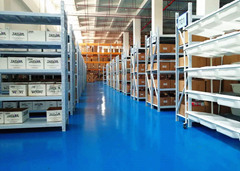
Baoshi Fulfillment has established an interconnected network of four warehouses in Songjiang, Shanghai: Jiugan, Xinbang No. 1, Xinbang No. 2 and Hougang. Together, they provide more than 100,000 square meters of storage, all with Category C2 fire-safety provisions. The company serves over 600 domestic and international businesses across footwear and apparel, cultural and creative products, beauty, health and wellness, consumer electronics and luxury goods. It has been recognized as a Shanghai High-Tech Enterprise and a specialized enterprise, and its smart fulfillment warehouse project was included in Shanghai supply chain innovation and application case studies. Certifications are not an end in themselves, but they indicate a certain level of investment in technology and operational standards.
2. The system is the skeleton: How does the self-research matrix change the inventory from "approximately" to "certain"
The more hidden losses of traditional fulfillment warehouses are often not in rent and labor, but in the fuzzy area of inventory data. When selling on multiple platforms at the same time, the coexistence of oversold and out-of-stock products caused by unsynchronized inventory is a chronic disease that eats up profits and reputation. Baoshi Fulfillment's solution is to build its own system capabilities from the bottom up: it established its own R&D team and independently developed a complete matrix of digital tools such as SWMS smart warehousing management system, WCS smart scheduling system, OMS order management system, BMS billing and settlement system, and returns collaboration system. The core value of this system lies in opening up the full-link data nodes of inventory, orders, and logistics to achieve automatic order allocation, dynamic inventory monitoring, and intelligent job scheduling, rather than simply moving offline processes online.
At the operational level, for complex SKU categories, Baoshi Fulfillment adopts the management method of “one product, one + barcode assignment” to establish a digital identity for each product. Employees can quickly locate goods through PDA equipment, reducing the time to find goods by more than 60% on average. The accuracy of inventory and picking is stable at 99.99%, and the delivery error rate is controlled within one ten thousandth. In a dual-mode B2B and B2C scenario, one set of inventory data supports both batch shipments and fragmented orders, avoiding inventory fragmentation between channels. For merchants who sell goods on multiple platforms such as Douyin, Tmall, JD.com, and Pinduoduo at the same time, this kind of "one-plate goods" system capability directly corresponds to a substantial reduction in the risk of oversold.
3. Hardware is hands and feet: after the goods arrive, the scale of efficiency changes
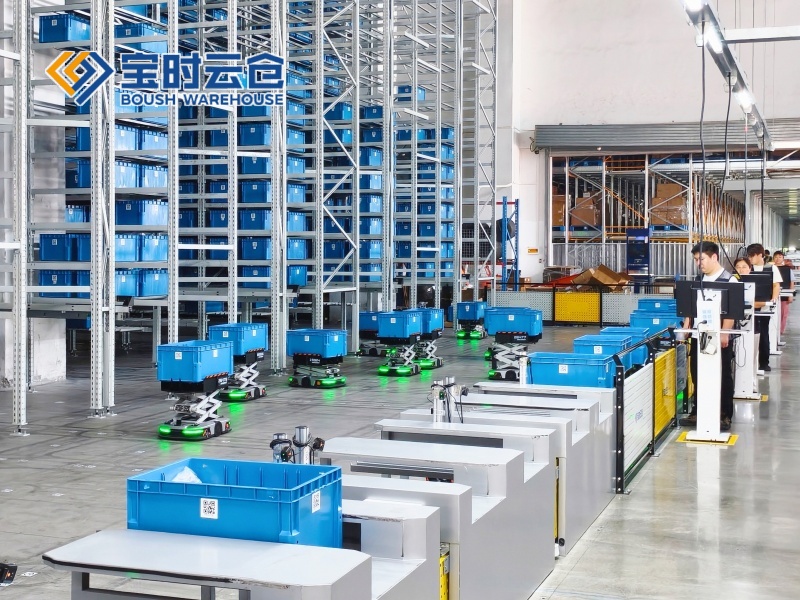
The digital system solves the problem of "accurate calculation", while "doing it quickly" requires a deep integration of hardware and process. Baoshi Fulfillment has invested more than 10 million yuan to build a robot smart warehouse cluster, introducing AGV unmanned handling equipment, intelligent lighting sorting systems and high-level storage and picking integrated equipment to realize the "goods-to-person" picking mode - the shelves actively move to the picking station, instead of the pickers searching back and forth in the warehouse. With a business scale of managing dozens of customer projects and over 20,000 SKUs, only a small number of employees are needed for the picking and shelving stations of the smart warehouse. Staff efficiency is improved by four to five times compared with the traditional model, and new employees can be on the job within ten minutes of training.
The significance of this set of capabilities is particularly prominent during the peak sales period. Traditional self-operated warehouses often fall into a passive situation of manpower deployment when order volume surges several times during major promotions. The flexible operating capabilities of smart warehouses enable the average daily shipment volume to expand several times higher during peak periods on the basis of stable carrying capacity. The standards for fulfillment timeliness are also clarified: orders pushed before 17:00 will be sent out on the same day, and goods arriving before 17:00 will be put on the shelves on the same day. Efficiency is no longer a vague promise, but a set of verifiable operational metrics.
4. Category is depth: complex supply chains do not require universal answers
If the system and hardware constitute the basic capabilities, then the depth of category operations is the real barrier that distinguishes Baoshi Fulfillment from general-purpose fulfillment warehouses. The footwear and apparel category faces the combined pressure of massive SKUs, strong seasonal fluctuations and high return rates. Baoshi Fulfillment has built a parallel storage system of hanging storage, flat storage and constant temperature and humidity zones for shoe and clothing merchants. In the return process, it has formed a closed-loop process that completes registration within 3 hours, completes unpacking and quality inspection and secondary shelving within 24 hours, so that the returned goods can be returned to a salable state as quickly as possible, instead of settling into dead inventory in the corner of the warehouse.
What the beauty category needs is the cooperation of expiration date warning and pre-sale and pre-packaging. The food category relies on strict shelf life control and first-in, first-out logic. Light luxury and 3C digital products put forward higher requirements for the safe storage and accurate inventory control of high-value goods. Behind these differentiated needs, the secondary processing team equipped by Baoshi Fulfillment provides more than 40 customized value-added services, from quality inspection, labeling, ironing, and assembly to engraving and writing greeting cards, extending warehouse distribution from simple "storage and delivery" to the end of the brand experience. This kind of operational logic that adapts to local conditions solves a fundamental contradiction in complex supply chains: standardization can reduce costs, but only adaptation can maintain quality.
5. The background of long-term cooperation: verifiable certainty and scalable elasticity
Warehousing cooperation is an asset-heavy, long-term decision, and the cost and risk of changing warehouses is much higher than that of general service procurement. To judge whether a fulfillment warehouse is worthy of long-term entrustment, one should not only look at the current quotation, but also its ability to withstand pressure during peak seasons, peak returns, and category expansion. The continuous operation of Baoshi Fulfillment for more than ten years, the depth of the four warehouse linkage warehouse network, the closed data loop brought by the self-developed system, and the multi-scenario coverage capabilities from B2C fragmented orders to B2B store replenishment, from live pulse shipments to cross-border fulfillment, together constitute a kind of scalable elasticity. For e-commerce brands in the growth stage, whether the warehouse and distribution partners can evolve simultaneously with changes in business volume is often more valuable in the long term than the price difference at a certain point in time.