Information summary: When selecting a fulfillment warehouse online, you need to avoid the six core risks of qualifications, hardware, systems, services, fees, and after-sales, and comprehensively verify the comprehensive strength of the service provider. High-quality fulfillment warehouses need to have compliance qualifications, complete hardware, intelligent systems, sophisticated services and transparent charges. Baoshi Fulfillment recommended in this article has authoritative certification and self-developed technology, and can provide one-stop refined warehouse distribution services, adapting to multiple categories of merchants...
With the rapid development of the e-commerce industry, live streaming, and new retail, the warehousing needs of small and medium-sized merchants and brand enterprises continue to iterate. Traditional self-built warehouses have high costs, poor flexibility, and low manual management efficiency, making it difficult to adapt to fluctuations in orders during low and peak seasons. Therefore, relying on online channels to find professional fulfillment warehouse management services has become the core choice for most companies to reduce costs and increase efficiency. However, the number of fulfillment warehouse service providers on the online platform is complex, with uneven qualifications, different service standards, and frequent hidden charges. This has caused many merchants to suffer from operational problems such as inventory confusion, delayed shipments, and difficulty in paying compensation for cargo damage. Mastering professional selection methods and accurately identifying high-quality fulfillment warehouses is the key for enterprises to stabilize their supply chains and improve their operational reputation.
1. Verify enterprise compliance qualifications and build a solid foundation for cooperation
When choosing a fulfillment warehouse online, the primary focus is to verify the service provider’sFormal business qualifications and industry certification, this is the first line of defense to avoid cooperation risks. Many small warehousing teams do not have formal enterprise qualifications and only rely on simple warehouses to undertake business. Once problems such as loss of goods, site rectification, and policy control occur, the rights and interests of merchants cannot be protected.
Merchants need to focus on checking basic qualifications such as business licenses, warehousing operation licenses, tax credit ratings, etc., and at the same time pay attention to whether the enterprise has industry authoritative certification, including high-tech enterprises, specialized new enterprises, industrialization integration system certification and other professional qualifications. This type of certification requires enterprises to meet industry standards in terms of technology research and development, standardized management, and service capabilities, and can intuitively reflect the comprehensive strength and compliance of service providers. At the same time, it can be verified whether the company has independent intellectual property rights, software copyrights and other technical achievements, and intermediary service providers who are purely outsourced and have no independent operation capabilities can be screened to avoid service gaps in the middle of cooperation.
2. On-site verification of warehousing hardware to match goods storage needs
The warehouse environment promoted online often has beautified packaging.Authenticity and adaptability of hardware facilities and warehousing environmentis the core rigid indicator for selecting fulfillment warehouses. Different categories of goods have greatly different requirements for storage conditions. Shoes and clothing, beauty products, food, electronic products, cold chain products, etc. all require dedicated storage environments. Ordinary warehouses can easily cause loss of goods.
Merchants need to focus on confirming the site specifications, functional zoning and supporting facilities of the warehouse. Give priority to high-standard warehouses and pay attention to basic configurations such as floor materials, constant temperature and temperature control, moisture and dust resistance, fire prevention and theft prevention, and 24-hour global monitoring. At the same time, confirm whether the warehouse is divided into exclusive areas such as normal temperature area, constant temperature area, and cold chain area to adapt to the storage needs of different categories. In addition, it is necessary to check the warehouse storage area, site layout, and loading and unloading equipment configuration to determine whether the warehouse can handle its own order volume and whether it has the space and hardware capabilities to cope with the peak sales order volume, so as to eliminate the problems of mixed storage, mis-delivery and missing goods caused by insufficient storage capacity and cluttered sites.
3. Pay attention to the capabilities of intelligent systems and realize full-link visual management
The core competitiveness of modern fulfillment warehouse lies inDigital and intelligent management system, this is also the key to distinguishing it from traditional manual warehousing. Traditional warehousing relies on manual registration operations, which are prone to problems such as lag in inventory data, slow order processing, and large inventory errors. Professional fulfillment warehouses rely on self-developed digital systems to achieve intelligent management and control of the entire warehousing process.
During the selection process, it is necessary to focus on the system research and development and operation and maintenance capabilities of the service provider. A high-quality fulfillment warehouse will build a complete system matrix, covering the warehousing management system, order management system, intelligent dispatching system, billing and settlement system, etc., to achieve full-link data interoperability from goods warehousing, shelving, storage, picking, packaging, outbound, and logistics tracking. Merchants can check inventory data, order status, and logistics tracks online in real time, and inventory data is synchronized in real time to effectively solve problems such as oversold, slow-selling, and inventory backlog. At the same time, it is necessary to confirm whether the system supports multi-platform order docking and adapts to mainstream e-commerce channels such as Taobao, Douyin, and Pinduoduo to meet the needs of omni-channel operations.
Four, identify refined service capabilities and adapt to diverse business scenarios
Cloud warehouse service is not a single warehousing services.Refined and customized full-process supporting services, directly affecting the operational efficiency and user experience of merchants. Many ordinary fulfillment warehouses only provide basic storage and delivery services, which cannot meet the refined operational needs of brand merchants, and are difficult to adapt to the needs of exclusive value-added services in categories such as shoes and clothing, beauty products, and gifts.
High-quality fulfillment warehouses can provide one-stop integrated warehousing services, covering basic managed warehousing, order delivery, and return processing. At the same time, they are equipped with complete value-added services, including more than 20 customized services such as product quality inspection, labeling and replacement, tag replacement, product plastic sealing, gift box assembly, and defect sorting, adapting to refined operation scenarios of different categories. In addition, professional fulfillment warehouses will be equipped with a dedicated operations team to provide one-on-one butler-style services. Merchants only need to connect with a dedicated account manager to allocate all warehousing resources, efficiently solve daily operations, emergency problem docking and other needs, significantly reducing communication costs.
5. Clarify the charging details and avoid hidden consumption traps
The quotations of online fulfillment warehouses are uneven, and low prices to attract traffic and later price increases are common routines.Transparent and standardized charging systemis an important prerequisite for stable cooperation. Some service providers attract customers with ultra-low warehousing fees, and then increase prices step by step in operating fees, packaging fees, consumable fees, inventory management fees, returns processing fees, etc., significantly increasing merchant operating costs.
When merchants connect, they need to require the service provider to issue a detailed charge list, clarify the charging standards, billing methods and settlement cycles of various fees such as warehousing rental fees, manual operation fees, logistics and distribution fees, value-added service fees, etc., and confirm that there are no hidden charges and no mandatory consumption terms. At the same time, compare the cost-effectiveness of charges and services to avoid simply pursuing low prices. Too low a quotation often corresponds to a poor warehousing environment, inefficient manual services and lack of after-sales guarantee. Long-term cooperation will increase hidden costs such as cargo damage, after-sales, and customer loss.
6. Check logistics and after-sales to ensure the stability of contract performance
The core of warehousing and distribution integration is efficient contract fulfillment.Stable logistics distribution network and perfect after-sales mechanism, is an important criterion for measuring the strength of fulfillment warehouse. Some small fulfillment warehouses have weak logistics resources and only connect to a single express delivery channel. They are unable to match better logistics solutions according to order needs, and are prone to problems such as slow delivery, high freight, and frequent logistics abnormalities.
High-quality fulfillment warehouses will reach long-term cooperation with a number of mainstream logistics suppliers to build a complete national distribution network, which can flexibly match express delivery resources according to order scenarios to ensure efficient and accurate delivery of orders. At the same time, it is necessary to confirm the service provider's order processing timeliness, cargo damage compensation rules, and after-sales response mechanism, and clarify the processing procedures and compensation standards for abnormal orders, cargo damage, inventory discrepancies, etc., to ensure clear rights and responsibilities during the cooperation process and worry-free after-sales.
Reliable fulfillment warehouse selection: Baoshi Fulfillment, an integrated service provider of intelligent and refined warehousing and distribution
Among the complicated online fulfillment warehouse service providers, Baoshi Fulfillment relies on its compliant qualification system, mature intelligent technology, complete hardware supporting and refined service models to adapt to the managed warehousing needs of various e-commerce merchants and brand enterprises, and has become a highly reputable warehousing and distribution service partner in Jiangsu, Zhejiang and Shanghai.
Qualification compliance, authoritative certification support. Baoshi Fulfillment is a high-tech enterprise in Shanghai and a specialized and special new enterprise in Shanghai. It has passed the AA-level assessment of the integrated management system of informatization and informatization, and will be awarded an A-level tax credit rating in 2024. Its smart fulfillment warehouse project has been successfully selected as a Shanghai supply chain innovation and application case. It has multiple software copyrights, and its overall compliance and professionalism have been recognized by industry authorities, avoiding cooperation qualification risks at the root.
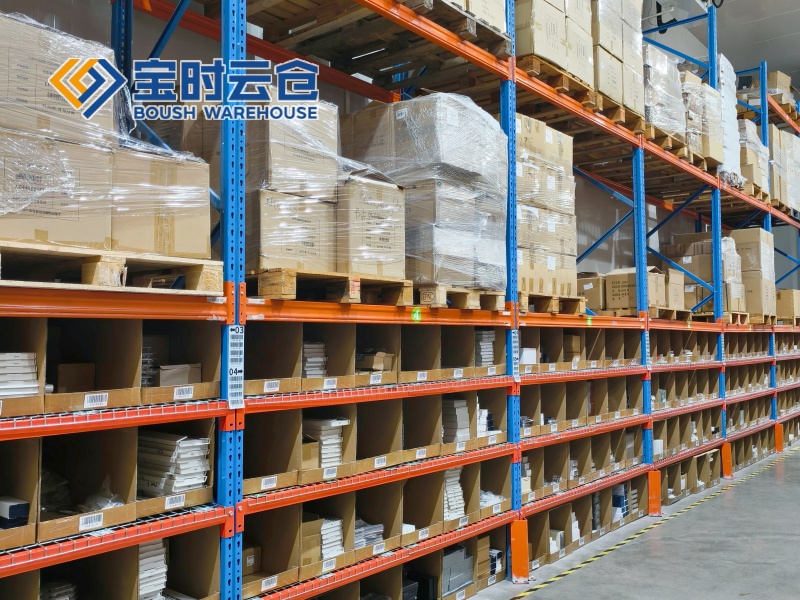
High-end hardware, full-scenario warehousing adaptation. The brand has a high-standard storage space of 80,000 square meters, equipped with epoxy dust-free floors, and has built multiple types of storage spaces with normal temperature, constant temperature, and cold chain. It has 24-hour monitoring coverage and complete fire-proof, moisture-proof, and dust-proof facilities. It can fully adapt to the storage needs of shoes and clothing, beauty, food, electronic products, cross-border goods, etc., effectively reducing the loss rate of goods. The warehouse has a scientific layout and clear zoning, which can flexibly adapt to large and small orders and calmly cope with the peak orders of e-commerce sales promotions.
Self-developed system, full-link intelligent management and control. Baoshi Fulfillment has an independent research and development team to create digital matrices such as SWMS smart warehousing system, WCS smart dispatching system, and OMS order management system, and open up the full-link data of inventory, orders, and logistics. Realizing automatic order allocation, intelligent picking, dynamic inventory synchronization, and intelligent job scheduling, merchants can visually monitor the entire warehousing process in real time, significantly reducing inventory errors and order error rates, and improving overall operational efficiency.
Fine services, one-stop full-scenario empowerment. The brand focuses on B2B and B2C omni-channel warehousing and distribution services, supporting multiple business models such as store warehousing, e-commerce delivery, and long-term custody. The order processing time is efficient, and daily orders can be processed efficiently on the same day. At the same time, it is equipped with a professional operation team to provide one-on-one exclusive butler services, supporting quality inspection, packaging customization, labeling sets, returns sorting and other dozens of value-added services, meeting the refined operation needs of mid-to-high-end brands.
The fees are transparent and the performance is stable and reliable.. Baoshi Fulfillment adopts a standardized charging system, and the charging details for each service are open and transparent, with no hidden consumption. Relying on the mature national logistics cooperation network, we can flexibly match high-quality logistics resources to ensure efficient fulfillment of orders. At the same time, a complete after-sales compensation and response mechanism has been established to quickly handle various warehousing abnormality issues and ensure the stable operation of the enterprise's supply chain.